
Products and Services

In-box Desiccants

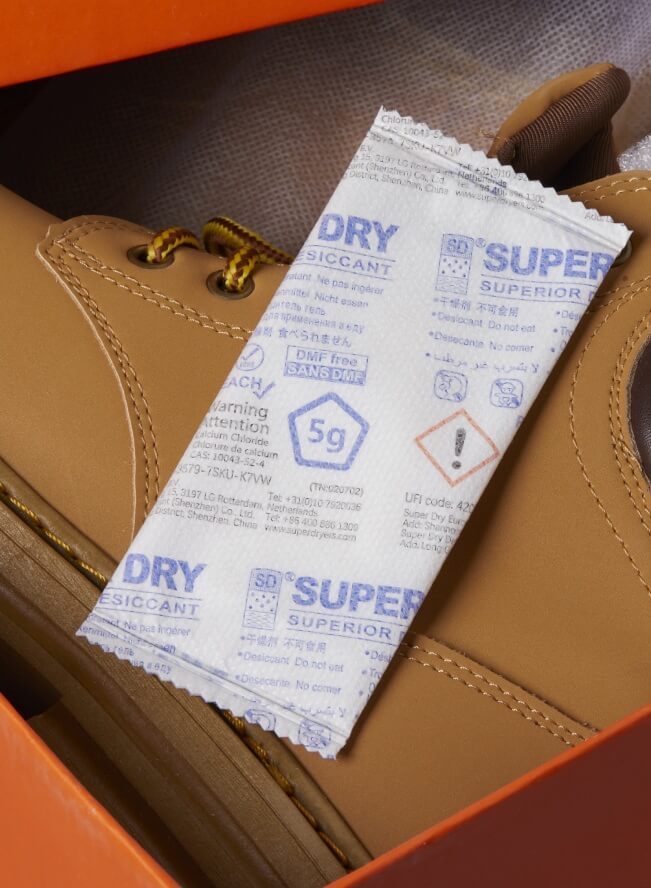
SUPER DRY in-box desiccants are engineered for application in transport and product packaging, like cartons, boxes, or poly bags.

In-box desiccants are applied to products which itself are hygroscopic, like garments, wood, and leather articles, or with cargo sensitive to corrosion. The desiccant controls the moisture inside the product packaging. Potential moisture sources are moisture released from the goods itself, from the packaging materials, like carton boxes or wooden crates or moisture diffusing through the packaging material into the inner packaging. Placed together with the goods, SUPER DRY in-box desiccants target excessive moisture inside the packaging, ensuring that your goods arrive in perfect condition.
Our Products

SUPER DRY in-box desiccants are available in a range from 2g to 100g, for application in different packaging sizes:

What Is Clay Desiccant?

Clay desiccant is a moisture-absorbing material made from naturally occurring montmorillonite or bentonite clay that has been thermally activated. It works by adsorbing water vapor into its internal structure without undergoing physical or chemical changes. Because it is non-toxic, biodegradable, and inexpensive to produce, activated clay desiccant is one of the most commonly used desiccants in commercial packaging. It’s ideal for protecting moisture-sensitive items, such as metal parts, electronics, pharmaceuticals, and food packaging.

Clay desiccant packs adsorb moisture through a physical process in which water molecules are trapped in the porous structure of the clay particles. The clay doesn’t swell or dissolve but simply holds moisture within its microscopic pores. These packs perform best in environments with moderate humidity (up to ~50% RH) and are effective across a temperature range of -20°C to +50°C. Once the clay is saturated, it no longer absorbs moisture, which is why proper sizing and quantity are key to effectiveness.

Clay desiccant bags are used across many industries to prevent corrosion, mold growth, spoilage, and other humidity-related issues. Their natural properties and cost-effectiveness make them ideal for:

  • Electronics Packaging: Protects sensitive circuits, displays, and battery components from moisture damage during storage and transit.
  • Pharmaceutical and Medical Equipment: Maintains low humidity inside sterile packaging to preserve shelf life and product efficacy.
  • Metal and Machinery Parts: Helps prevent rust, oxidation, and surface degradation in tools, automotive parts, and precision instruments.
  • Textile, Leather, and Footwear: Keeps garments, leather goods, and shoes dry and mildew-free during cross-border shipping.
  • Food and Nutritional Supplements: Controls residual moisture to help retain product texture, flavor, and stability in snacks, powders, and capsules.